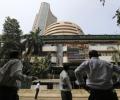
'It is easy to dramatise the events of today, but it is far more important to focus on the fact that we have a radically overvalued financial sector. It is a house of cards.'

We asked colleagues, present and past, to reflect on a man who has made such a difference to their lives and careers. Here it is then, a rich collection of memories that offer enchanting glimpses of the enigmatic Ajit Balakrishnan.

Traders hope elections will see BJP winning a majority to usher in reforms and pull the economy out of the current slow growth.

Besides foreign flows, corporate earnings and US Federal Reserve chief Janet Yellen's testimony to the nation's legislature are also likely to impact investor sentiment.

The trend was visible in the early trade on Thursday as investors indulged in trimming their bets after the minutes of the US Federal Reserve's September meeting indicated a possible rate hike this year.

PowerGrid was the top gainer in the Sensex pack, rising around 4 per cent, followed by NTPC, Tata Steel, Bharti Airtel, Sun Pharma and Bajaj Finserv. On the other hand, IndusInd Bank, Asian Paints, Infosys, Bajaj Auto and Maruti fell up to 2.59 per cent.

'Overall, the Indian economy is doing well.' 'Our economic fundamentals are strong and the early signs of recovery are sustainable.' 'This is positive for the market in the long run.'

'Hope they don't tinker around with capital gains tax in any way.'

'To the believers of crypto regulations, I have only one question to ask, how will you regulate it?'
They straddle many different (non-financial) lines of business with sometimes opaque overarching governance structures.

Fitch Ratings on Tuesday retained India's economic growth forecast at 7 per cent for the current fiscal, but cut projections for the next two financial years saying the country is not impervious to global developments. In its December edition of the Global Economic Outlook, Fitch projected India's GDP to grow at 7 per cent in the current fiscal, at a slower rate of 6.2 per cent in 2023-24 and at 6.9 per cent in 2024-25. In September, Fitch projected 7 per cent growth for the current fiscal, followed by 6.7 per cent in 2023-24 and 7.1 per cent growth in 2024-25.

The ballooning of crude prices has significantly increased the country's oil import bill and it can also lead to a worsening of the current account deficit and fiscal deficit for the domestic economy.
Of the 70 international feeder funds, more than half have made losses in 2014.

The rupee is currently hovering around Rs 65/USD at 2-year lows.

'In the short term, we may see some disruptions due to Covid, but in the medium-to-long term, we should keep an eye on US inflation and 10-year bond yields.'
.jpg)
According to sources, the company has identified smaller markets such as Peru, which do not contribute significantly to profits, where it might shut shop in the near term.

'The Fed rate will peak in the range of 5.1-5.3 per cent during the second quarter of CY23 and will most likely stay there for a while before rate cuts start in CY24.'

In line with Sensex, the broader indices also saw hefty losses. Large cap index tumbled 0.79 per cent, midcap 0.87 per cent and smallcap 0.57 per cent.

The wider NSE Nifty touched a low of 10,652.40 before finishing at 10,671.40, showing a loss of 97.75 points, or 0.91 per cent.

Investors turned cautious weighing weak GDP numbers and continued drop in automobile sales, bringing banking and auto sector stocks under pressure.
Analysts believe that investors should look at stocks that hit 52-week lows only if they have a dividend paying track record, are debt-free and have sound fundamentals.

Higher interest rates in the US do not necessarily coincide with capital outflows.

'Some risks to this market rally include inflation, erratic weather conditions, rising crude prices, slowing global growth and the resultant impact on domestic exports, escalation in geopolitical tensions.'

Forex dealers said besides robust month-end demand for the American currency from oil importers, dollar's strength against its rival currencies on expectations of rising interest rates amid lingering Sino-US trade tensions, weighed on the domestic currency.
Any change in rates would mean more volatility; else, poll outcome-fuelled rally expected to continue.
While far from being a currency war, India does not have much of an option but to depreciate to accommodate its exports at a time when China shows its intent to let its currency depreciate.

The net leasing of Grade-A commercial office space in India will stagnate this financial year at 32-34 million square feet, with global uncertainties brewing caution among key tenant categories, according to the latest Crisil Ratings report. Major seven cities in India - Bengaluru, Chennai, Hyderabad, Kolkata, Mumbai Metropolitan Region (MMR), National Capital Region (NCR) and Pune - had Grade-A office space with an operational stock of around 705 million square feet as of March 2023. India's commercial office space is dominated by technology companies, with information technology (IT) and IT-enabled services (ITeS) companies occupying 42-45 per cent of the operational stock.

The majority in the markets believe that a September lift-off is likely.

The retail industry witnessed robust top-line growth for the greater part of the previous financial year, but demand has started to show signs of fatigue seen in the January-March quarter (fourth quarter, or Q4) of 2022-23 (FY23), especially in the apparel and innerwear segments. Jewellery, however, has managed to hold on to demand in the quarter. "In the discretionary space, demand moderation in urban markets is expected to impact the quick-service restaurant and apparel categories the most, while paint, luggage, and jewellery should see resilient growth," Systematic Institutional Equities observed in its preview of the sector.

The fragmentation of politics and the pressures of coalition management have contributed to a near-secular rise in budgetary social expenditures and spending on subsidies since 1991, leaving little fiscal space for government-led capital investment.

The International Monetary Fund (IMF) warned on Tuesday that India's general government debt (comprising both central and state government debt) could exceed 100 per cent of gross domestic product (GDP) in the medium term. It also cautioned that long-term debt sustainability risks are high due to the significant investment required to meet India's climate change mitigation targets. The Indian government, however, disagreed, arguing that risks from sovereign debt are extremely limited as it is predominantly denominated in domestic currency.

The results of the study, being published on the website of top academic journal Nature on May 20, implied the Huanan Seafood Market in Hubei's capital Wuhan may not be the birthplace of COVID-19, although the virus outbreak emerged in Wuhan had a strong link to contacts with the market.
It is by now quite clear that in all likelihood the US Federal Reserve will hike interest rates in its next meeting in mid-December.

Expectations of continued stimulus withdrawal by the US Federal Reserve added to the market's gloom.

10 non-bank and non-finance stocks from the BSE500 Index universe that offer an optimal blend of low valuation, reasonably robust revenue and earnings growth in recent quarters, a strong balance sheet, and most importantly, positive cash flow from their operations.

Given the reality of the disparity and the enormous shift over the last 50 years, this can be done without an open and frank conversation with the people, something that has not begun and, knowing the style of our leader, is not expected to begin, asserts Aakar Patel.
Equity benchmark indices Sensex and Nifty buckled under selling pressure after a nine-session rally on Monday, as massive sell-off in IT, tech and telecom counters unnerved investors.

For financial sector companies setting up shop in India, as of now the go-to regulators are obviously Sebi and the RBI with carve-outs for IRDAI or possibly PFRDA. But this could change soon with the International Financial Services Centres Authority, observes Subhomoy Bhattacharjee.

What China's market crash means for India

Equity benchmarks erased early gains after realty, capital goods, teck, auto, PSU, IT, power and bankex counters came under selling pressure, falling up to 1.28 per cent.
